Blog Archive

The Power of Interest


We all know about the power of positive thinking, but did you know that just showing interest in something makes a positive difference? In this short inspirational animation derived from Ilchi Lee’s lectures, see what happens when you take an interest in and send love even to an inanimate onion. It’s easy to see how the power of interest can change the world.

Competitiveness in a Fair and Honest Society

The curious case of former Illinois governor, Rod Blagojevich, has been a frequent topic of conversation, especially after the recent court verdict against him. He was impeached by the Illinois legislature for accepting bribes and corruption between 2003 and 2008. As someone who is not native to the United States, it is surprising that this level of corruption could exist in 21st Century American politics.

However, corruption is not limited only to politics. The overall atmosphere of our society is one in which “honesty” has not been considered an important value. People who will use any means to get what they want have occasionally been regarded as clever, while the honest and conscientious have at times been despised as weak and naïve.

Ilchi Lee agrees with Abraham LincolnGiven the widespread influence of this atmosphere, the importance of “living honestly” is not taught to children as much as it used to be, not even at home or at school. Talk about working to create a “fair society” and you find some actually worrying that this might hurt a nation’s competitiveness. Would it really?

No, it wouldn’t. These are merely the groundless fears of a distrustful society dominated by unfair rules. Since people think that they will be at a loss if they are the only ones who try to be honest, they use only a minimum effort. Studies have actually been done on how much trust contributes to economic growth, how ethical behavior positively impacts human life.

“Every time a society’s level of trust goes up 10 percent, its rate of economic growth rises 0.5 to 0.8 percent,” according to a study by Byung Ki Lee of the Korean Economic Research Institute. Suppose our society’s level of trust rises 10 percent. That could create over $8.6 billion in growth. So we can see that moral conscience contributes to massive increases in economic value.

“A child with a high morality index is highly competitive and has a high happiness index,” revealed Geum-ju Kim, a professor of education at Seoul National University. Research has shown that children who live with a good conscience are more confident in their own futures and more positive about life.

Ilchi Lee Ruskin honestyWith integrity declining in political, economic, and educational circles, modern society has many contradictory elements when it comes to teaching our young children moral conscience. Children learn unconsciously that many of the values they are taught in the classroom don’t apply outside of it. Consequently, at the present time, the only solution is for parents and teachers to serve consciously as good examples often.

Our country’s standard of living will rise automatically once our society teaches that, “the life most worth living is one that contributes to the good of all.” What is the main culprit that is damaging the nation? It is selfish values that say, “Me, my children, and my family are all that matters.” This paradigm narrows our field of vision and makes us corrupt. A consensus that “this is wrong” must be formed if we are to stop our car from racing down the road of an outdated and ill-fated paradigm.

We can expand our perspective and change our lives for the better when we each realize that our own success is tied to the success of others, and that helping others is helping ourselves. We can expect genuine progress in our society when we are able to develop the desire to do good for each other.

Can You Feel Your Feet?

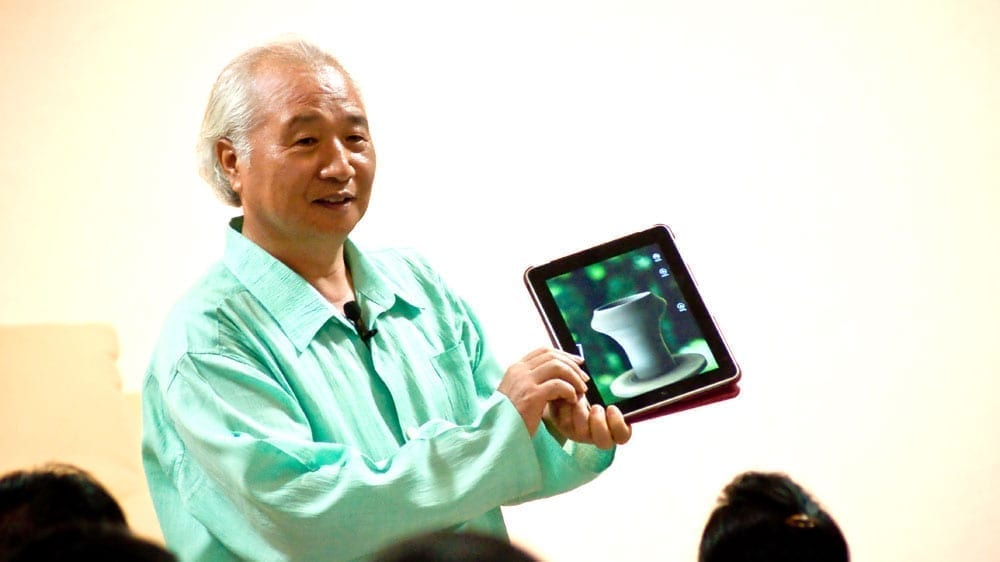
I spend a lot more time in front of a screen these days—using my computer, my smartphone, my iPad. Although I am enjoying all the things I can do with this technology it can sometimes make my head feel heavy, and I am reminded that many people suffer from various ailments from spending too much time in front of a screen. It can contribute to anxiety, stress, insomnia, even physical ailments such as headaches and constipation, among others.

Ilchi Lee Healthy Energy FlowThat’s what happens when the body’s ki, or life energy, pools in your head without circulating to the rest of your body. Energy must flow smoothly in a certain way in order for us to be healthy. Your heart generates fire energy, which should flow down into your abdomen and then up to your kidneys. Your kidneys should cool that energy and create water energy that flows up to your head. The flow of energy in this manner creates balance. Both physical and emotional–the “fire in the belly” of a person of action and the “cool head’ of a great decision-maker. I call it “Water Up, Fire Down.”

When we pay too much attention to a screen or other things outside of ourselves, our energy collects in our head, creating a lot of extra thoughts. Our extra thoughts create more thoughts whirling around in our minds in an endless cycle, while our lower body loses energy and our energy flow becomes the reverse of Water Up Fire Down. It can cause you to disconnect from yourself, as well as the earth and the other life forms on it, losing interest and concern for them.

There are many ways to counteract this effect, but one simple one is to focus on the part of your body that’s the furthest from your head–your feet. How often do you ever actually think about your feet? What would happen if you did? Well, let’s try it.

Try standing up on both feet right now. If possible, remove your shoes and socks. Imagine your feet are stuck to the floor without any space between. If you stand this way and quietly focus on the soles of your feet, at a certain point, you will feel as if the weight of your whole body is in your soles. Then feel that weight being sent to the earth beneath you, while at the same time feel the strength of the earth holding up your weight. Ground the soles of your feet to the earth.

This feeling of weight is not merely a physical sense. It is a vivid sensation of life, of being present. It is the feeling of “Here I am, I’m alive,” and of gratitude and humility toward the earth. This feeling sustains your body and life, and comes from deep within your heart. It’s only available when you are living in the moment.

I stay still and sometimes I lift up both hands and hold them in front of my chest as through I am holding a huge jar or have my arms around a large tree. This is a complete kigong posture. If I stand like this, feeling the soles of my feet as I make my breath steady and deep, my whole body becomes filled with energy. If I stand like this for just five minutes a day, I can create and maintain healthy Water Up, Fire Down energy circulation. I can return to my work with clarity and a sense of calm. With this I can easily counter the effects of too much time in front of a screen.

World Insights:
Peace in the Face of Terror

Last week, more than 2,500 tourists were cleared from the Eiffel Tower and surrounding areas after a bomb threat was called in to Paris police. The international media kept the world on alert throughout the day, as people wondered what this new terror threat would bring. The bomb threat turned out to be a hoax. However, the event brought home the reality that even though 9 years have passed since the September 11th attacks in the U.S., we still live under the threat of war and terror.

Ilchi Lee celebrates International Day of PeaceBut we have not entirely given up hope. Today, September 21st, is the International Day of Peace, a date that was designated by the United Nations General Assembly in 2001 as an annual day of non-violence and cease-fire. Before that, the first Day of Peace had been celebrated every year since September 1982 on the opening day of the UN General Assembly. It provided an opportunity for individuals, organizations, and nations to act for practical peace. In honor of Peace Day, many places around the world hold events such as vigils, lectures, dances, concerts, sporting events, peace pole and tree plantings, cease-fires, and giving humanitarian aid.

In this spirit, members of the Earth Citizen Movement in the Washington, DC area will host a five-day event called Earth Citizens for Peace, which will culminate in a Walk for Peace on Saturday, September 25th. Donations will go to the UNICEF Campaign to Prevent Mother-to-Child Transmission of HIV (MTCT), as part of the UN’s Millenium Development Goals, through the International Brain Education Association (IBREA).

As you can see by these recent events, we live in a world of both endless terror threats and an endless endeavor to keep the peace. Like one traditional Native American story says, in the human mind there is a good wolf and a bad wolf. The two are often in conflict. Which one do you think wins? The strongest one is the one you feed. The good wolf does not win over your heart and mind automatically.

So which wolf are we as humanity feeding now? We need to look carefully. Which wolf are you feeding in your own life, in your beliefs? Which wolf is being fed in your country, in your family, in your community?

Someone who is in tune with their conscience can recognize the good wolf, the wolf with a conscience inside Ilchi Lee feed the good wolfthem. If they look carefully, they will know which wolf is the one to feed with their thoughts, words, and deeds. If the wolf with conscience in each of us becomes bigger and bigger, then our world will become a society of conscience. When that happens, don’t you think our world could be peaceful? Now is the time in which the recovery of humanity’s conscience and the recovery of our highest human values are crucial.

Compliments vs. Criticism

As a student, I had just about no luck when it came to awards. Thanks to an attention deficit disorder I had when I was young, I had built such a wall between myself and my academic studies, that I never had one proper notebook’s worth of notes until my high school days. Throughout my entire time at school, the only award I ever received consisted of an award for effort from my second grade homeroom teacher in elementary school. My mother had taught me how to read clocks, and thanks to that, every time my teacher asked me what time it was, I was able to give the right answer. My teacher was pleased, and as he tousled my hair, he told me to keep up the good work and gave me an award for effort. As soon as school was out for the day, I ran home at breakneck speed and proudly regaled my mother with the day’s events.

For a kid who had always been dejected, my teacher’s compliment gave me much encouragement and strength. From that day on, I listened to my teacher faithfully. Then one day, upon hearing the news that he would be working at another school, I ran several miles after him down a newly constructed road and grabbed him as he was about to board a bus to beg him not to go. Judging by how the memory of the one time I received a compliment in school still remains fresh in my memory, it is certain that my brain likes compliments. And I think most people’s brains like compliments.

Ilchi Lee Thumbs UpCompliments are usually a pleasant experience for anyone. It is a human characteristic to try to repeat an experience that is pleasant. Thus, receiving a compliment increases the likelihood that a person will repeat that behavior. Our brain likes the surging of positive emotion that accompanies a compliment, and therefore remembers it better than anything else. According to neuroscientists, when a person receives a compliment, a substance called dopamine is secreted leading to the development of motivation and vitality, and even the immune system is said to be strengthened. Furthermore, giving or receiving a compliment reduces a hormone called norepinephrine, said to be released in the brain when under stress. Indeed, it seems that compliments are a veritable vitamin for maintaining brain health.

However, our society is not so very generous with compliments. Instances of being reprimanded for doing poorly are far more numerous than those in which a job well done is duly noted. Consequently, we aren’t so good at receiving compliments. But I think if the world won’t compliment me, I should compliment myself. We have been incessantly taught to be considerate toward others and compliment them, but when it comes to ourselves, it seems like we’ve learned that being harsh and causing pain is a sign of humility and virtue.

Instead, I think complimenting myself is a form of self-respect. There is much that we can fail in and become depressed with ourselves about. However, no matter how much we repeat our mistakes and failures, as long as we respect ourselves, we can start over again at any time. We can stand up again, and we can have hope.

Just as people who have received their parents’ love know how to love others, those who know how to love and cherish themselves are truly able to love and demonstrate consideration for others. We really need to give ourselves the gift of praise in order to give ourselves joy and encouragement. We put so much effort into our lives. Rather than reproaching ourselves, let us give compliments.

E-Newsletter Archive